





Hi everyone,
I’m trying to better understand the data flow and potential throughput dependency in the following Auxiliary Copy scenario in Azure.
We have two Azure MediaAgents:
Copy-2 Azure MediaAgent → Azure Blob Storage (region-local Storage Account)
Copy-2 Azure MediaAgent → Copy-3 Azure MediaAgent → Azure Blob Storage (associated storage account)
During the Copy-2 → Copy-3 Auxiliary Copy, Copy-2 data flow starting from reading the data from its associated Blob Storage, process it, and send it to Copy-3. Copy-3 then writes the received data to its own associated Blob Storage.
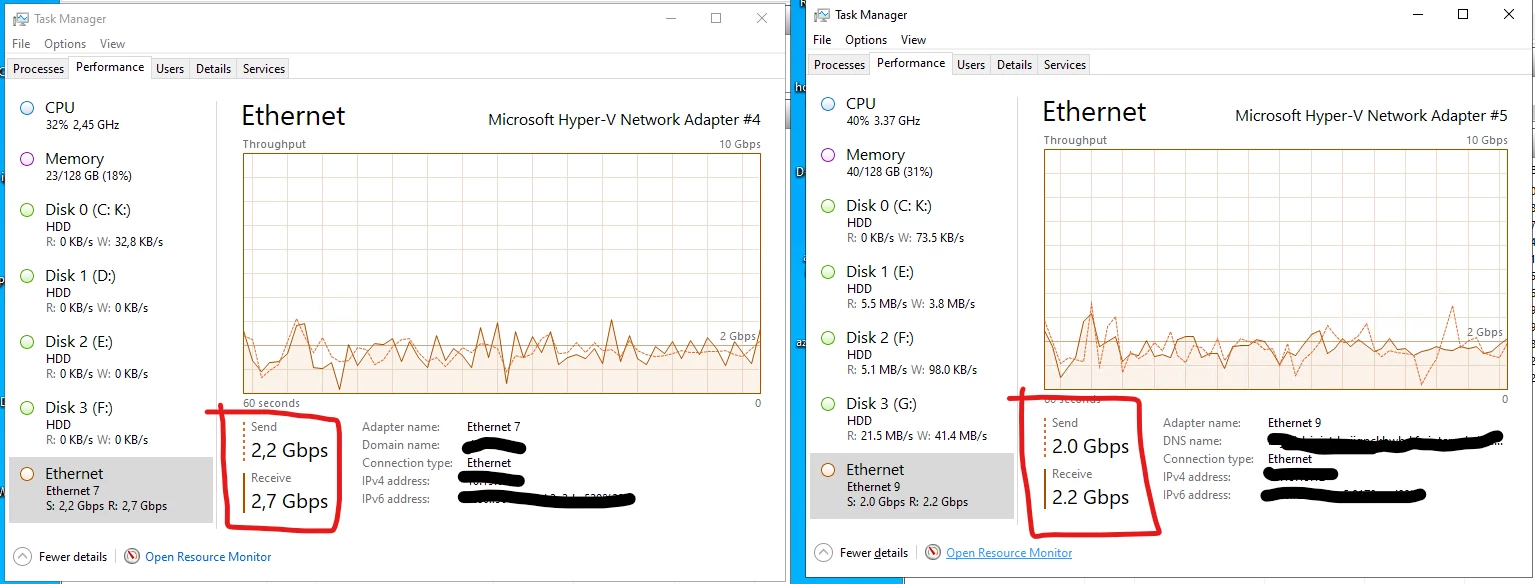
In our environment, the read/write throughput between Copy-2 and its associated Storage Account appears to be limited to approximately 3 Gbps.
What is interesting is that we also observe the Copy-2 → Copy-3 throughput reaching approximately the same ~3 Gbps level, even though the two Azure VMs communicate through Microsoft's Azure backbone using VNet Global Peering, which theoretically should support significantly higher throughput.
Here is a screenshot from an Auxiliary Copy running from Copy-2 to Copy-3. The network throughput on both MediaAgents appears to be very similar.
So my question is:
Can the read throughput from Copy-2's associated Blob Storage effectively limit the maximum throughput of the Copy-2 → Copy-3 Auxiliary Copy?
In other words, if Copy-2 can only read/process data from its associated Storage Account at ~3 Gbps, would this inherently limit the maximum data rate that Copy-2 can send to Copy-3, even though the underlying VM-to-VM network connectivity through VNet Global Peering is capable of much higher throughput?
Please for your feedback.
Best regards,
Nikos