Migrating Exchange Online Protection from EWS to Microsoft Graph: Post Your Questions Here
Ask questions. Find and share technical expertise, configuration tips, resilience best practices and more.
Recently active
As we have shared throughout the last year, Microsoft is retiring Exchange Web Services (EWS) for Exchange Online in two phases, with the first milestone commencing October 1, 2026. This thread captures key dates, transition paths, resources, and recommended configuration steps to take in your Commvault and Azure environments to help reduce the risk of interruption to supported Exchange Online protection. As you review your environments and take steps to migrate to Graph, we know questions will arise. Put your questions here and our technical experts will review and respond regularly. Note this transition impacts anyone backing up Exchange Online, inclusive of Commvault SaaS and on-prem software. It does not impact Exchange On-Prem users. Microsoft and Commvault feature support, dates, permissions, and transition behavior may evolve further. SummaryThis short video overview from our Readiverse Academy team summarizes key phases, dates, and critical steps to take in your environments.
View the complete webinar on-demand. Commvault PresentersSam Curcuruto - Director, Product Marketing Dinesh Reddy - Director, Product Management Suzanne Klausner - Director, Global Enablement Recap & HighlightsThis webinar introduces the Commvault Cloud SaaS and 11.44 LTS platform release and explores how organizations are adapting to a world where data is more distributed, identities are more dynamic, and cyberattacks are moving faster than ever. Resilience is increasingly tied to an organization's ability to secure data, control identities, detect risk, and recover cleanly and confidently following disruption. Platform Release 11.44 reinforces Commvault's commitment to helping organizations move beyond traditional backup toward a unified approach to cyber resilience—enabling teams to protect, detect, recover, and restore with greater confidence in the age of AI. The session includes demos of new innovations around expanded Identity Resilience and Active Directory security cap
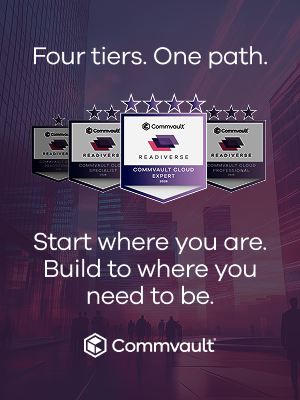
We’re excited to introduce a new, tiered certification path in Readiverse Academy, designed to help Commvault learners build the skills you need to operate, secure, and recover with confidence. As Commvault Cloud environments continue to evolve, teams need clear, role-based learning paths that support real-world responsibilities — from platform administration and workload protection to cyber resilience and recovery readiness. The new Readiverse Academy certification structure gives learners a guided path from foundational knowledge to advanced cloud engineering expertise. This is not a reset. It is a clearer roadmap for what to learn next. What’s New The programme now includes four certification tiers: Commvault Cloud Practitioner – foundational platform and cyber resilience knowledge Commvault Cloud Specialist – expanded operational, workload, and security depth Commvault Cloud Professional – advanced recovery and workload expertise, including Cloud Rewind or Cleanroom Recovery
Readiverse Academy is launching a new Tech Talks webinar series designed to help customers learn from experts, hear practical insights, and deepen their resilience skills. These technical, practitioner-focused sessions bring together Commvault experts and experienced practitioners to share real-world guidance, lessons learned, and best practices you can apply in your own environment.The first session took place on June 18, with additional webinars planned throughout the year. 2026 Tech Talks Schedule and Upcoming Sessions Air Date Topic Time (US ET except where specified) Registration Link 08 Oct 2026 Commserve Live Sync 09:00 am TBA 17 Sept 2026 Guide on Upgrading a CommCell 09:00 am Watch On Demand 28 July 2026 Platform Release Webinars (July 2026): Commvault Cloud SaaS and LTS 11.44 9:30 AM GMT | 11 AM SGT | 1 PM EDT Customers/all end users (on demand) 23 July 2026 Platform Release Webinars (July 2026): Commvault Cloud SaaS and LTS 11.44 9 AM SGT | 1
Click Here to view the full webinar recording. Commvault PresentersBiswanath Das – Senior Technical Trainer Prasad Nara – Senior Manager of Development Webinar Recap As organizations continue moving workloads and data to the cloud, backup environments are growing in scale and complexity. The Storage Accelerator Tech Talk discusses challenges with traditional backup architectures, where MediaAgents act as the data mover between clients and cloud storage. This dependency on MediaAgents can create bottlenecks, increase resource utilization, extend backup and recovery windows, and add operational overhead as environments scale. The Tech Talk focuses on how Storage Accelerator changes the data path by allowing clients to write data directly to a configured cloud storage pool rather than sending backup traffic through a MediaAgent for data transfer operations. The MediaAgent remains active for metadata-related functions such as indexing and deduplication, but the client acts as the data
We’re excited to announce that Commvault® Cloud Backup & Recovery for Microsoft Power Platform is now generally available (GA), starting with support for Power BI. This means you can now extend the same enterprise-grade data protection you already rely on to the Power Platform workloads supporting critical business operations.With this release, customers can protect business-critical assets such as reports through automated backups of Power BI workspace content, along with granular recovery for individual reports and folders – helping reduce downtime and minimize disruption caused by accidental deletion, corruption, or malicious activity. Key FeaturesAutomated, policy-based protection: Apply policy-driven backups across Power BI workspace assets, enabling consistent, scalable coverage without manual intervention. Rapid, granular recovery: Restore individual reports, folders to a specific point in time, avoiding manual rebuilds and helping minimize downtime and disruption. Isolated,
Web Console Deprecation – What Customers Need to Know Commvault is continuing its move toward a single, modern management experience through the Command Center. As part of this transition, the legacy Web Console has been officially deprecated and is no longer included by default in newer Commvault platform releases. This article explains what the deprecation means for you, when the Web Console may still be required, and how to request access if your environment depends on it. Why is the Web Console being deprecated? The Web Console is being retired as Commvault standardizes on the Command Center as its primary management and reporting interface. The Command Center provides equivalent or enhanced capabilities, improved security alignment, and is the strategic platform for all future feature development. Deprecation timeline • Version 11.38: Web Console interface marked as deprecated • Version 11.40: Web Console removed from the default installation media • Version 11.42 and later: Web
We’re pleased to share an important update to the Commvault documentation portal for Innovation release 11.42: a redesigned left-hand navigation panel that is now aligned with the structure of the Commvault Command Center interface.What’s ChangingIn the past, the organization of our documentation differed from the navigation experience within the product. This sometimes made it harder to move between the Command Center and supporting documentation.With this update, the documentation structure now mirrors the layout and logic of the Command Center. This creates a more intuitive and consistent experience when navigating between the product and its documentation.What This Means for YouEasier navigation between the Command Center and documentation Faster access to relevant information A more streamlined and consistent user experienceThis change is designed to help you find answers more quickly and reduce friction when using documentation alongside the product.We Value Your FeedbackAs you e
Our support ecosystem brings together skilled engineers, shared global knowledge, and continuous training. It also showcases the use of innovative technological advancements. One such innovation is Arlie, our AI-enabled support assistant.Arlie reads logs, identifies patterns, and surfaces insights before small issues turn into major problems, helping our engineers deliver faster, smarter resolutions. This lets the team focus more on understanding the customer’s situation and less on searching through raw data. Arlie is enabled for all SaaS customers by default in Command Center today and is available in Command Center starting with SP40 for software customers. Read more about enabling Arlie in the documentation here. You can also access it via arlie.commvault.com or through our Support portal. Having Arlie in our customers’ hands enables you to search for solutions directly without having to wait on Commvault. This can be a lifesaver while handling critical, time-sensitive issues. Arl
In today’s cloud-native world, your resilience depends on how fast you can bring entire environments—not just data—back to life after a disruption or attack. Cloud Rewind is helping organizations recover recovering full cloud environments, and in minutes not days.Check out the replay of our recent Customer Success webinar to hear insights and best practices from Nithya S, Manager – Customer Success for Commvault.In this webinar, Nithya covers a range of topics, including:Switching from runbooks to Recovery-as-Code to shrink RTO/RPO Agentless, automated infrastructure recovery—no scripting, no standby DR sites Protecting complex apps across regions, cloud accounts & platforms (AWS/Azure/GCP)Click here to view the webinar.
Have you ever meticulously restored an Azure SQL database from a .bacpac file, checked the job status, and breathed a sigh of relief when you saw "Success," only to be met with a wave of authentication failures and reports of orphaned users? It's a confusing and frustrating scenario. The portal says the operation was successful, the database is online, but your SQL logins and contained users are completely broken.This isn't a random glitch or a failed job that was misreported. It's a common situation that stems from the fundamental design of how Azure SQL Database handles users and logins during a .bacpac import. This article will demystify this behavior, explaining why it happens, why it's not a bug, and how a different authentication method sidesteps the problem entirely.--------------------------------------------------------------------------------1. Takeaway 1: The "Successful" Restore That Secretly Breaks Your SQL LoginsThe core of the problem is this: even when an Azure SQL Dat
Commvault is proud to announce our new designation as an ISC2 Authorized CPE Submitter Partner, recognizing our commitment to advancing cybersecurity knowledge and professional development.As an authorized submitter, Commvault can now report Continuing Professional Education (CPE) credits directly to ISC2 for participants who attend qualifying Commvault learning programs and events. This means professionals with certifications such as CISSP®, CCSP®, and SSCP® can automatically earn and track CPE credits through Commvault events without the need for manual submission. Empowering the Cybersecurity CommunityThrough this partnership, Commvault joins a select group of organizations authorized to deliver educational content aligned to ISC2’s domains, including:Security and risk management Cloud and network security Incident response and forensics Identity and access managementAttendees of Commvault webinars, workshops, events, and training courses will benefit from automatic credit reporting
Level Up Your Skills: Exciting New Courses and Catalogs Now Available! Hello!We’re thrilled to announce the release of our latest course catalogs designed to empower both our valued Customers and dedicated Partners. We firmly believe in continuous learning and providing you with the resources you need to excel and achieve your goals. Whether you’re looking to deepen your understanding of our products, expand your technical expertise, or improve your business capabilities, we have something new for you! For our Customers: We’ve curated a range of courses focused on maximizing your success with our offerings. These courses cover everything from foundational knowledge to advanced techniques, ensuring you can leverage our solutions to their fullest potential. For our Partners: We’ve developed updated training programs to equip you with the knowledge and skills to effectively represent and support our solutions. Stay ahead of the curve with courses covering the latest product updates, best
New portal shortcuts - click the link below based on your profile: CUSTOMERSPARTNERSWelcome to the Commvault Readiverse Academy, your new hub for learning and certifications! This FAQ document will guide you through the platform, answering common questions about access, exams, certifications, and more. We encourage you to explore the Readiverse Community forums (this space) further for the most up-to-date information and resources related to educational content. What is the Commvault Readiverse Academy? Accessing the Readiverse Academy Portal Partner Access and Partner University Transition Exams and Certifications Learning Resources and Content Support and Community What is the Commvault Readiverse Academy? The Readiverse Academy is Commvault's comprehensive learning platform, designed to empower our customers and partners with the knowledge and skills needed to be successful and resilient with Commvault solutions. As we continue to expand, the Readiverse will offer a wide range of re
Hello,We are currently investigating whether Commvault SQL Server Agent supports connecting to Microsoft SQL Server using TLS with TDS 8.0 and Strict Encryption.Our environment is configured according to Microsoft's guidance for SQL Server strict encryption:SQL Server is configured with a valid trusted certificate. TDS 8.0 is enabled. Strict Encryption is enabled. Connections using SQL Server Management Studio (SSMS) work successfully. Connections using PowerShell also work successfully.Reference: Connect to SQL Server with strict encryptionWhat we would like to know is:Does Commvault SQL Server Agent support connections using TDS 8.0? Does Commvault support Strict Encryption in the same way as SSMS and modern Microsoft SQL drivers? Which SQL client/driver version is used by Commvault when connecting to protected SQL Server instances? Is there any Commvault-specific configuration required to enable encrypted SQL Agent connections? Has anyone successfully protected SQL Servers that are
Hello team,Could you please provide some information regarding the ServiceNow and Zscaler backups? The details were visible on the portal until a few days ago, but they are no longer appearing. When can we expect backup availability for both?Thanks.
Dear Community, when is it planned to introduce support for LTO-10 Tapes? Best regards, Aleksandra
I find all jobs in waiting state e the volume offline.I restart Media agent and the volume comeback online, but the jobs stay in waiting mode , then I try to restart the comvault server (LIUX - Roky), but the server don’t start anymore and in boot screen appear the fail error : Failed to start D-Bus Dbus system message BUS.
Our Web Server has the Microsoft 365 apps version of Outlook installed to facilitate email previews and PST exports.Recently, there were issues with exporting to PST, exports would work sometimes but not consistently. What appears to have fixed this issue is disabling auto-updates and then downgrading to 20228.20190 by running:cd %ProgramFiles%\Common Files\Microsoft Shared\ClickToRun\ OfficeC2RClient.exe /update user updatetoversion=16.0.20228.20190 Now I’m running into an issue previewing emails in Compliance Search, which is also sporadic. The Error says 'Preview not available'. I did a test and when just using the default wildcard search, I selected an email, and saw the preview. I then performed a search, selected the SAME email, and it said 'Preview Not Available. Is this also Outlook related? What version of Outlook are people running?
Hi everyone,First of all, I have to say that Threat Scan in 11.44+ feels like a completely different product compared to 11.40. The improvements are significant, and the addition of VM workloads to the Threat Scan capabilities is a really nice enhancement. While going through the 11.44 documentation, I came across the following:“For Windows VM workloads, set up a Windows Threat Scan server.”“For Linux VM workloads, set up a Linux Threat Scan server.”Commvault Threat Scan Requirements My question is regarding whether this OS-specific requirement applies only to VM workloads, or also to File System workloads.For example, if an environment contains both Windows and Linux File System workloads, can we use a Windows Threat Scan server to scan both, or would we need separate Windows and Linux Threat Scan servers?In other words, is the Windows/Linux Threat Scan server distinction specifically related to the way VM disks/filesystems are mounted and accessed during VM Threat Scan, or does the s
I want to extend the retention of jobs that ran on a specific date (September 25) for a specific client. If I select the jobs and click Retain, will I be able to perform a complete restore? Will the dependent jobs also be retained?What is the best way to do this?
Hi everyone,Our CommServe is a VMware VM with 32 GB RAM, but lately memory utilization is consistently around 90% as the environment grows. We have multiple VMware, Azure, AWS, OCI, LiveSync and Microsoft 365 environments, although the total number of VMs is not particularly high.SQL Server Maximum Server Memory is already configured at ~16 GB, so SQL is not consuming all available memory. Would it be necessary to increase the CommServe all the way to 64 GB RAM, or would a lower intermediate value be sufficient to provide additional headroom?Since it is a VMware VM, we can increase RAM independently without necessarily increasing vCPU. CPU utilization is currently not a concern.What would you consider the best approach in this situation?Best regards,Nikos
We are using a self-hosted Commvault environment. Backup history reports show only about one backup cycle (roughly 14 days), even after testing 90- and 365-day retention periods. Older job history is unavailable, which prevents us from producing complete monthly backup reports.We understand that the older “Days to keep the successful backup job histories” setting is no longer available in current versions. We have opened a case with Commvault Support, but have not yet found a clear explanation or supported workaround.Has anyone else experienced this in a recent Commvault release? What is the supported way to retain successful backup job history for reporting after the older control was removed? Please include your Commvault version and any confirmed resolution.
How fresh install for version 11.44 on win and requirement for success process
Hi everyone,We are currently facing a Commvault backup issue on Nutanix AHV.The initial problem was related to HotAdd / SCSI device detection on the Commvault Access Node. To fix that first issue, we had to add the following additional setting on the Access Node:VirtualServer\bEnableSCSIWLunDeviceCleaner = TrueAfter enabling EnableSCSIWLunDeviceCleaner, the initial HotAdd issue was resolved.The logs now confirm that the disk is correctly attached and opened:Disk [SCSI.0] is attached at [/dev/sdb]Opened [/dev/sdb] successfullyHowever, we are now facing a different issue when Commvault calls the Nutanix Data Protection APIs.The compute-changed-regions call returns:HTTP 401Invalid cookies present in the requestCommvault then reports:JWT Token has likely expired. Trying Discover cluster againDuring the new cluster discovery attempt, Nutanix returns:HTTP 429Failed to perform the operation as rate limit set by the API has been exceededPLAT-10003 - RATE_LIMIT_EXCEEDEDThen compute-changed-regi
Already have an account? Login
No account yet? Create an account
Enter your E-mail address. We'll send you an e-mail with instructions to reset your password.